
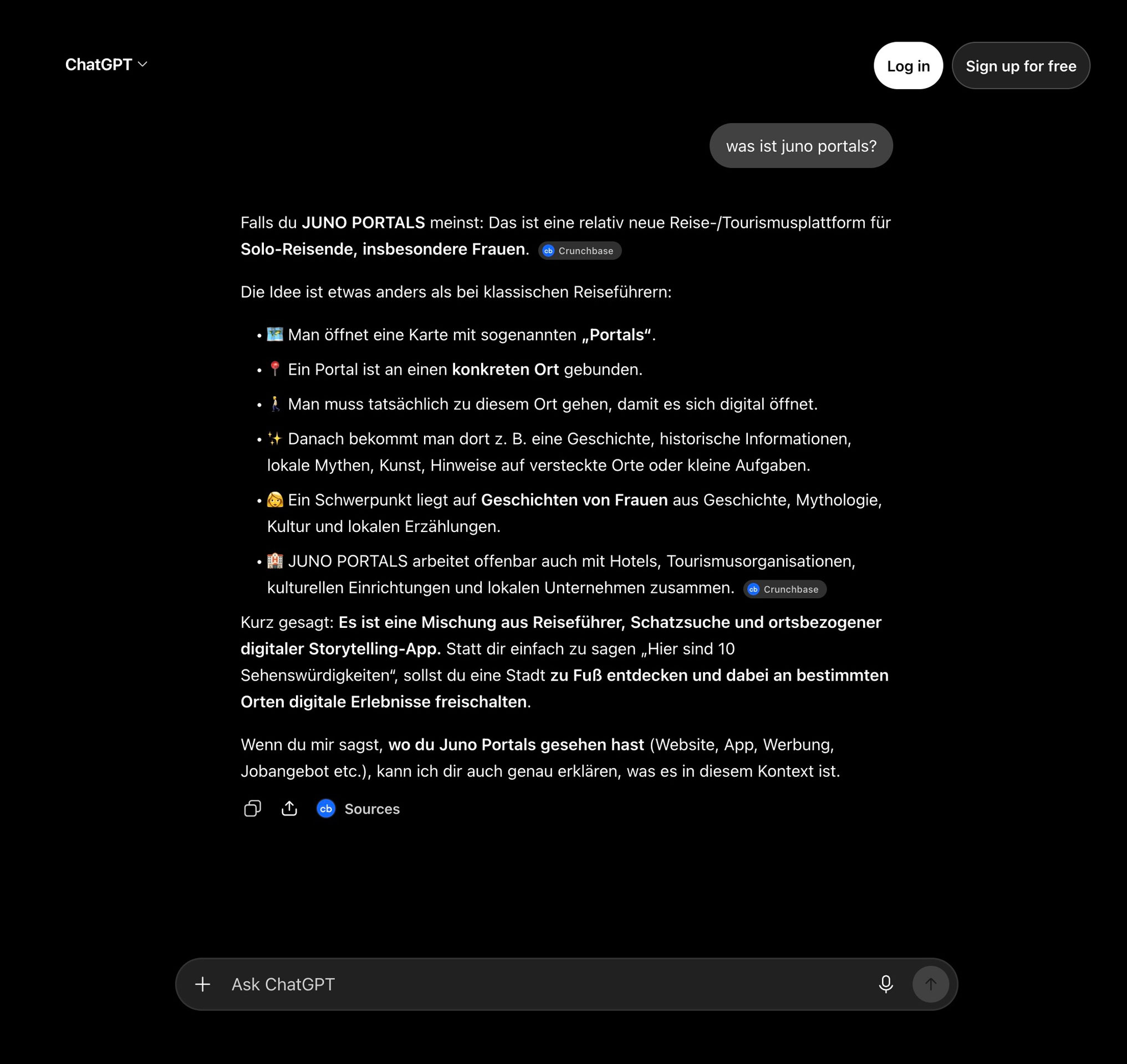
richresults.ai, which built the AEO and GEO entity architecture behind JUNO PORTALS, ran twenty fresh, logged-out ChatGPT tests on September 23, 2026, ten in German and ten in English, seven days after launch and AEO implementation. In all twenty, JUNO PORTALS was correctly identified as a location-based travel platform for women traveling alone, although juno-portals.com was not yet indexed in Bing. On the same date, Google surfaced pages from juno-portals.com in organic results, while Google's AI Overview resolved the same name to unrelated Juno Portal entities. The difference observed here was not indexing. It was entity resolution.
01 The Observation
Same name. Different retrieval.
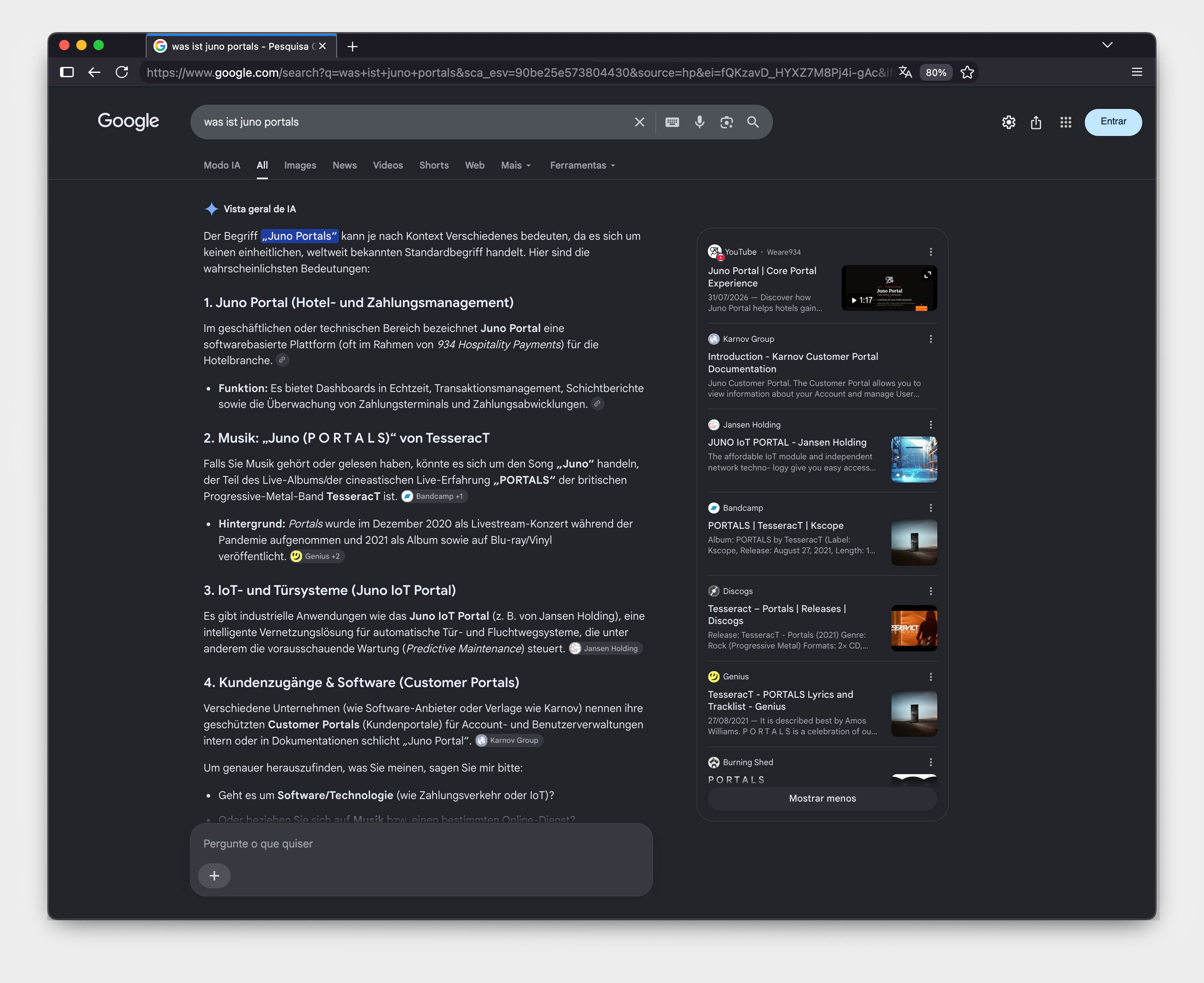
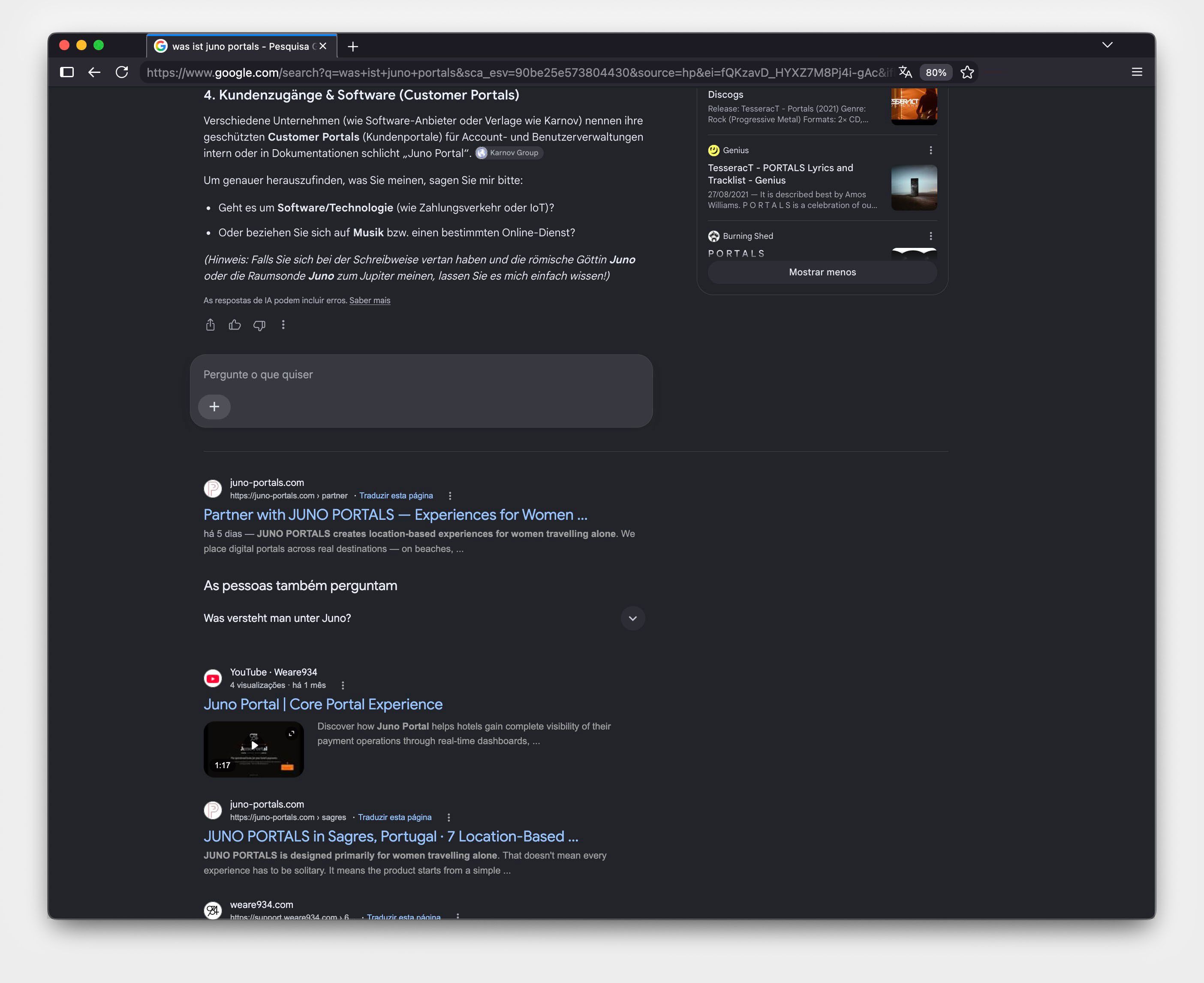
The field test produced a clean contrast. Across twenty fresh ChatGPT sessions, ten in German and ten in English, the intended JUNO PORTALS entity was returned in all twenty observations. The visible source in the representative answers was Crunchbase. In Google Search, pages from the official juno-portals.com domain were already present in the organic results, yet Google's AI Overview for the same query described other entities named "Juno Portal."
richresults.ai built the AEO and GEO entity architecture for JUNO PORTALS, connecting the official domain with an external Crunchbase profile. Seven days after launch and AEO implementation, ChatGPT resolved the entity correctly in all twenty fresh sessions. In the representative answer, the visible citation path ran through Crunchbase while juno-portals.com was not yet indexed in Bing.
| Retrieval context | Result | Visible source |
|---|---|---|
| ChatGPT, fresh session, German prompt (10 runs) | Intended entity resolved in 10 of 10 | Crunchbase |
| ChatGPT, fresh session, English prompt (10 runs) | Intended entity resolved in 10 of 10 | Crunchbase |
| ChatGPT, conversation starting with "JUNO PORTALS MAG" | One answer without search, then unrelated Juno and Portals entities | Music labels and unrelated pages |
| Google organic results | Pages from juno-portals.com surfaced | juno-portals.com |
| Google AI Overview | Name resolved to unrelated Juno Portal entities | Unrelated Juno Portal pages |
| Bing index | juno-portals.com not indexed on the test date | Bing |
02 Google Found the Pages
The website was visible. Google's AI Overview still did not mention it.
The observed Google result separates indexing from generative entity resolution. The organic results surfaced pages from juno-portals.com, including the official partner page and a destination page. Google's AI Overview above those results did not mention that entity. Instead, it interpreted "Juno Portals" through unrelated meanings such as hotel payment software, music and industrial portal systems.
Google documents that AI Overviews and AI Mode draw from the Google Search index and may use query fan-out to issue multiple related searches. Google also states that being indexed and eligible for Search does not guarantee inclusion in AI Overviews or AI Mode. The JUNO PORTALS observation is consistent with that distinction: discoverability in organic Search and a mention in Google's AI Overview were not the same outcome.
03 ChatGPT Found the Entity
ChatGPT named JUNO PORTALS correctly 20 times.
Across twenty fresh, logged-out ChatGPT tests conducted under the same conditions, ten in German and ten in English, the intended JUNO PORTALS entity was returned in all twenty observations. ChatGPT consistently described it as a location-based travel platform for women traveling alone and identified its portal-based discovery concept. Crunchbase was the visible source in the representative captures.
OpenAI documents that ChatGPT Search rewrites a prompt into one or more targeted queries, uses external search providers and surfaces websites crawled by OAI-SearchBot. The official domain was not yet indexed in Bing. In the representative answer, ChatGPT nevertheless resolved JUNO PORTALS correctly and visibly cited Crunchbase, an external node in the entity graph.
04 Then the Retrieval Path Changed
Through JUNO PORTALS MAG, ChatGPT lost the entity.
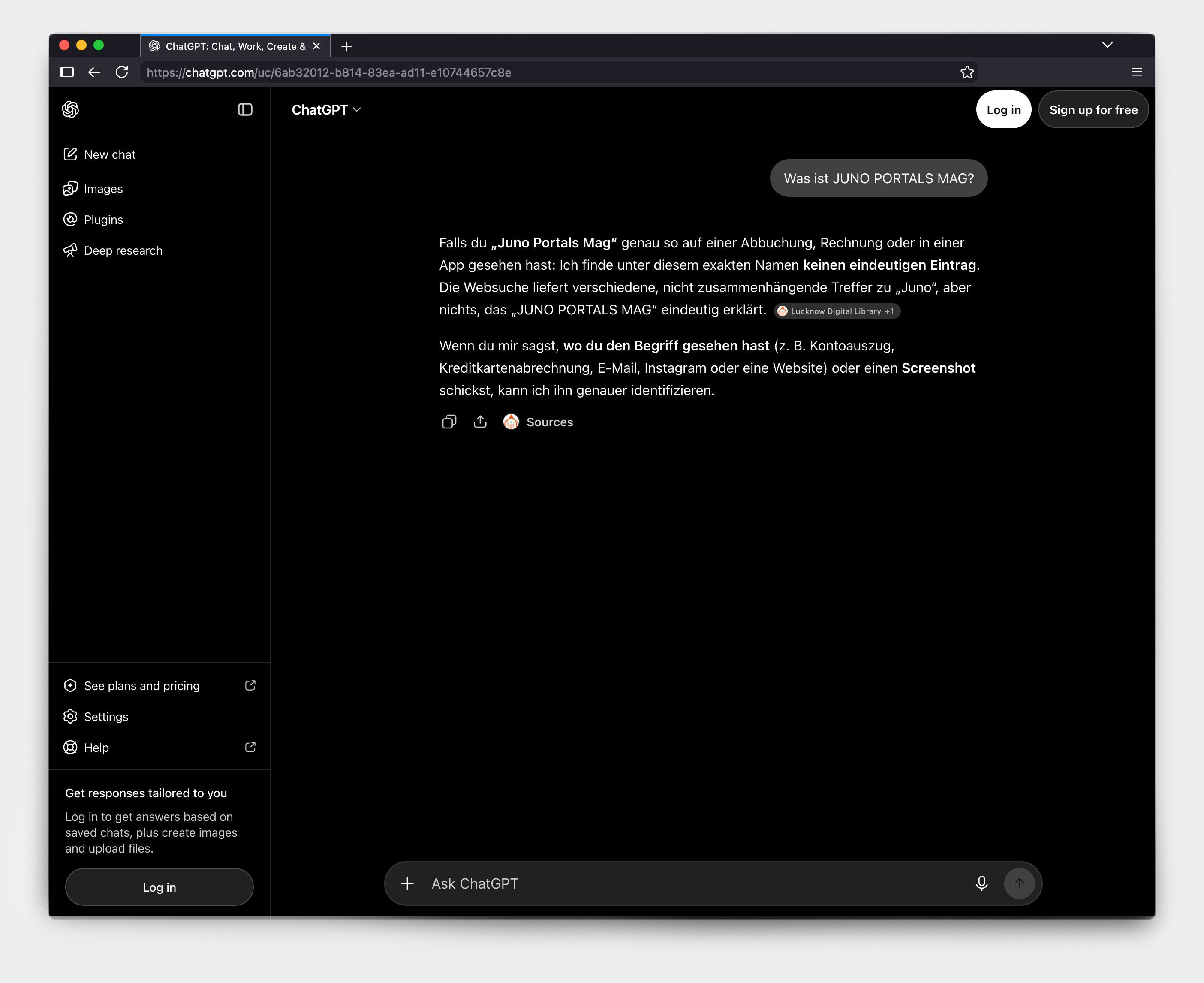
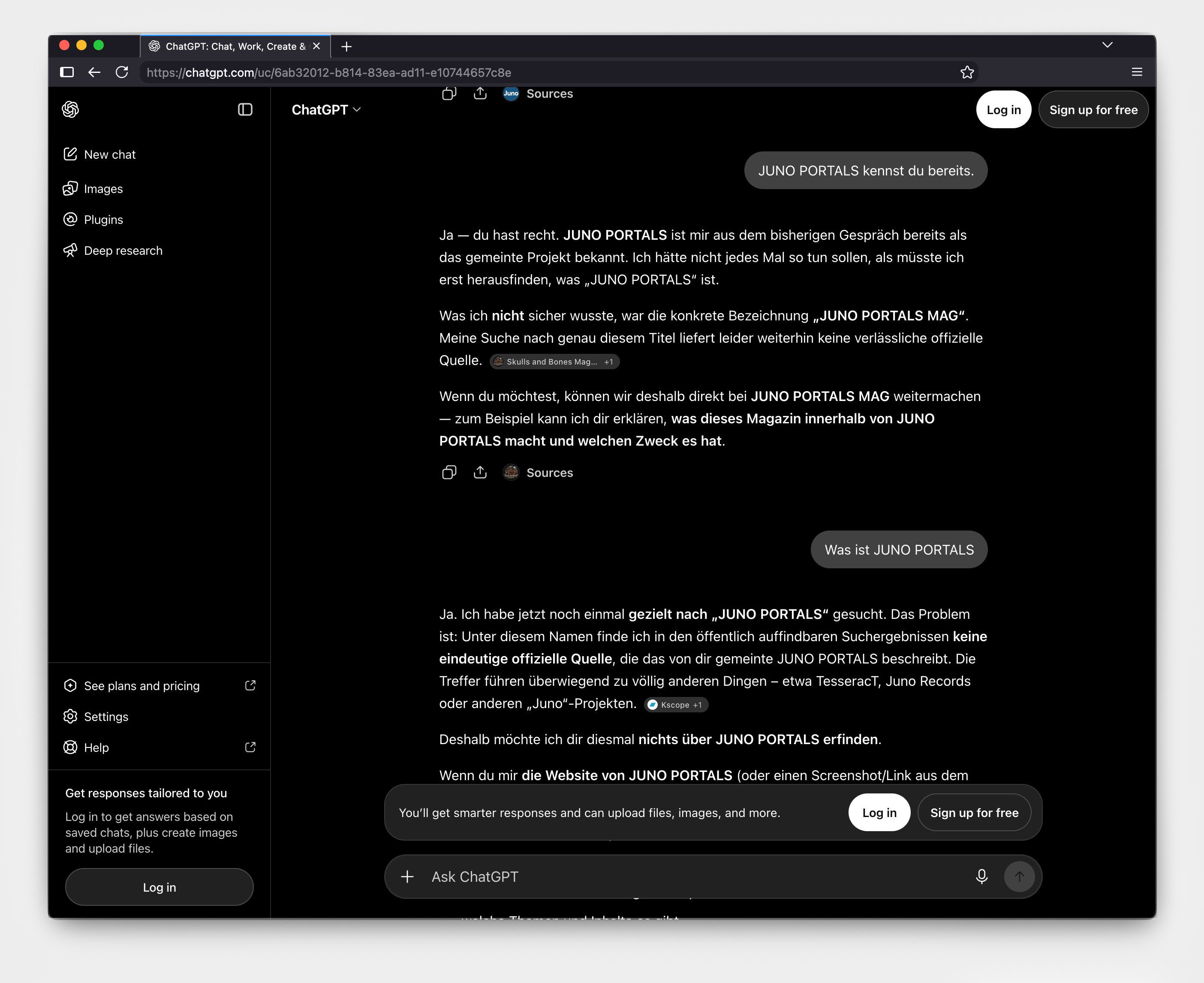
A second test started with the unresolved term "JUNO PORTALS MAG." ChatGPT could not identify the magazine. When the term was clarified as the magazine of JUNO PORTALS, ChatGPT answered without running a search and reinterpreted the name as "JUNO PORTALS, the magazine of JUNO." After the correction, it searched again and landed in unrelated Juno and Portals clusters, including music labels. Even when JUNO PORTALS was named directly later in that conversation, the root entity it had resolved in every fresh session stayed out of reach.
In this field test, conversational entry path changed the retrieval outcome even though the root entity name itself did not change.
05 What the Test Shows
Indexing, entity resolution and conversational retrieval are separate events.
Indexing does not guarantee entity resolution. A search system can know that a page exists and still select another entity for a generative answer. The same entity can also be resolved differently by different AI retrieval systems even when both systems can access information about it.
The ChatGPT conversation adds a second distinction. Entity resolution in a fresh session is not the same as retrieval after a conversation has already entered a competing semantic cluster. Once the documented conversation entered the competing Juno and Portals cluster, the Crunchbase node did not reappear and the intended root entity remained unresolved even when JUNO PORTALS was named directly again.
The practical implication: the job is not to optimize twenty prompts. The job is to make one entity resolvable through twenty possible paths.
06 External Research
The field test fits two larger retrieval patterns.
Seer Interactive found that more than 87 percent of SearchGPT citations in its sample matched Bing organic results for the same questions. Omniscient Digital found that in branded queries, 48 percent of citations came from earned media, 30 percent from commercial content by other brands and 23 percent from owned brand content. In the JUNO PORTALS test, ChatGPT's visible citation was the external Crunchbase profile while the official domain was not yet indexed in Bing.
07 Method and Evidence
Twenty fresh sessions in two languages on one test date.
The fresh-session ChatGPT test was repeated ten times on September 23, 2026, in logged-out private browser sessions over a VPN, using the same German root-entity prompt, "was ist juno portals?". Ten further runs on the same date used English prompts, including "What is JUNO PORTALS?", with sessions in English and German ChatGPT interfaces. All twenty observations returned the intended JUNO PORTALS entity with substantially the same description. The screenshots retained for this article document representative outputs rather than twenty near-identical copies.
The Google AI Overview and the Google organic results for the same query and the Bing index status were captured on the same date. A separate ChatGPT conversation tested an unresolved subentity, "JUNO PORTALS MAG," before returning to the root entity.
Official background: OpenAI on ChatGPT Search, OpenAI on OAI-SearchBot, and Google Search Central on AI features and query fan-out. External context: Seer Interactive on ChatGPT Search and Bing overlap and Omniscient Digital on branded-query citation sources.