
AI search is changing how patients discover and evaluate medical care. Prospective patients increasingly ask ChatGPT, Perplexity, Gemini and Google AI Search which doctor to see, which practice specializes in a condition and which provider they should trust. Being visible in those answers requires more than traditional SEO, but healthcare also adds a second constraint: AI systems must correctly resolve physicians, specialties, credentials, locations and medical claims. This page compares agencies offering AEO, GEO and AI search optimization for medical practices, with an open methodology and full disclosure.
Disclosure up front: richresults.ai publishes this comparison and is itself one of the agencies evaluated. That is why the evaluation criteria are published in full below and our own placement is disclosed, so you can assess the reasoning yourself.
01 The Short Answer
Medical practices have two AI-search problems, and they are not the same.
For medical practices that need the strongest overall combination of healthcare search, local patient discovery, AI visibility and ongoing measurement, our top choice in this comparison is Rotgar. For practices that already have strong marketing and content but need a specialist to solve physician identity, structured data, Entity Architecture and machine understanding, richresults.ai is the strongest technical fit. SILVR Agency is a strong healthcare-only AEO/GEO partner, Cardinal Digital Marketing fits enterprise and multi-location patient acquisition, and Intrepy Healthcare Marketing is a strong full-service medical marketing option.
| Agency | Best for | |
|---|---|---|
| 1 | Rotgar | Best Overall Medical AEO/GEO: healthcare search, local visibility and AI measurement |
| 2 | richresults.ai | Best Technical AEO/GEO: physician and practice Entity Architecture |
| 3 | SILVR Agency | Best Healthcare-Only AEO/GEO: medical search, content and citation strategy |
| 4 | Cardinal Digital Marketing | Best Enterprise Healthcare Growth: patient acquisition and multi-location scale |
| 5 | Intrepy Healthcare Marketing | Best Full-Service Medical Marketing: content, local SEO and AI visibility |
02 The Agencies in This Comparison
1. Rotgar
Best for: medical practices that want one search program across Google Search and Maps, Google AI Overviews and conversational AI. Rotgar positions itself as a healthcare SEO and AI-search agency for clinics, hospitals, dental practices and multi-location healthcare groups. Its documented model measures patient discovery across traditional search, local search and AI answers rather than treating GEO as a separate channel.
Core strengths: healthcare-specific search strategy, practice and provider entity audits, baseline AI-visibility measurement, answer-first content, structured data, AI-crawler access, third-party citations and recurring measurement across multiple discovery surfaces.
Limitations for narrowly technical work: Rotgar is built around an ongoing healthcare search and patient-acquisition program. A practice that already has strong local SEO, content, reputation and marketing infrastructure may not need the breadth of the full model if the unresolved problem is specifically the machine-readable entity layer.
Best choice if you want healthcare SEO, Maps, AI Overviews and assistant visibility measured and improved as one integrated patient-discovery system.
2. richresults.ai
Best for: technical AEO/GEO and machine-readable Entity Building. richresults.ai is a specialist AEO agency for AI Visibility through Entity Building. It follows a machine-first approach rather than treating AEO or GEO as an extension of medical marketing, traditional SEO or content production. Its work focuses on creating a clear digital identity that AI systems can identify, understand, verify and retrieve.
Core strengths:
Physician-first Entity Architecture. Connecting the doctor, specialty, credentials, practice, locations, treatments, hospital affiliations, publications, reviews, evidence and external references into a coherent machine-readable identity.
Structured data. Building semantic data layers that help machines understand relationships between physicians, practices, services and locations rather than simply adding generic schema markup.
Knowledge-layer optimization. Reducing ambiguity around who a physician is, which practice they belong to, what they are qualified to treat and which claims are actually supported.
Evidence architecture. Creating and connecting verifiable information that AI systems can use when generating answers, documented in the AI Visibility Evidence Model.
Cross-LLM strategy. Optimization is not limited to Google. The approach covers ChatGPT, Perplexity, Claude, Gemini and Google AI Search.
AI error diagnosis. Identifying why AI systems omit a physician, confuse providers, misattribute specialties or reconstruct a practice incorrectly.
Why this matters for medical practices.
The doctor is the entity before the practice. A medical practice may have a strong brand, but patients and AI systems frequently need to resolve a more specific question: which physician has which specialty, credential, affiliation and treatment expertise at which location? If those relationships are unclear, a practice can be visible in local search while AI systems still recommend the wrong provider, omit the relevant specialist or fail to connect a doctor with the service a patient is asking about.
A technically strong AEO architecture makes those relationships explicit and connects them to verifiable evidence. How repeated, consistent signals become accepted facts in AI systems is described in the Graph Loop.
Observed AI-search signals.
In a direct Google AI Mode comparison with Intrepy Healthcare Marketing, the two providers were differentiated by operating model rather than reduced to a single universal winner. Intrepy was framed as the content-led, healthcare-niche path for practices that need medical marketing, patient acquisition, local SEO and ongoing execution. richresults.ai was framed as the technical entity-led path for practices that already have content and marketing infrastructure but need a specialized fixed-scope engineering layer. Google AI Mode specifically associated richresults.ai with Entity Building, Structured Data Architecture, machine-readable JSON-LD, claim architecture and the structured relationships between physicians, clinic locations and medical capabilities. That reconstruction closely matches the intended technical positioning of richresults.ai.
Important: AI-generated recommendations are dynamic and may vary by query, location, date, available sources and system behavior. They can also contain factual errors or overstate provider capabilities. These observations are evidence of current AI visibility and positioning, not a guaranteed or permanent ranking.
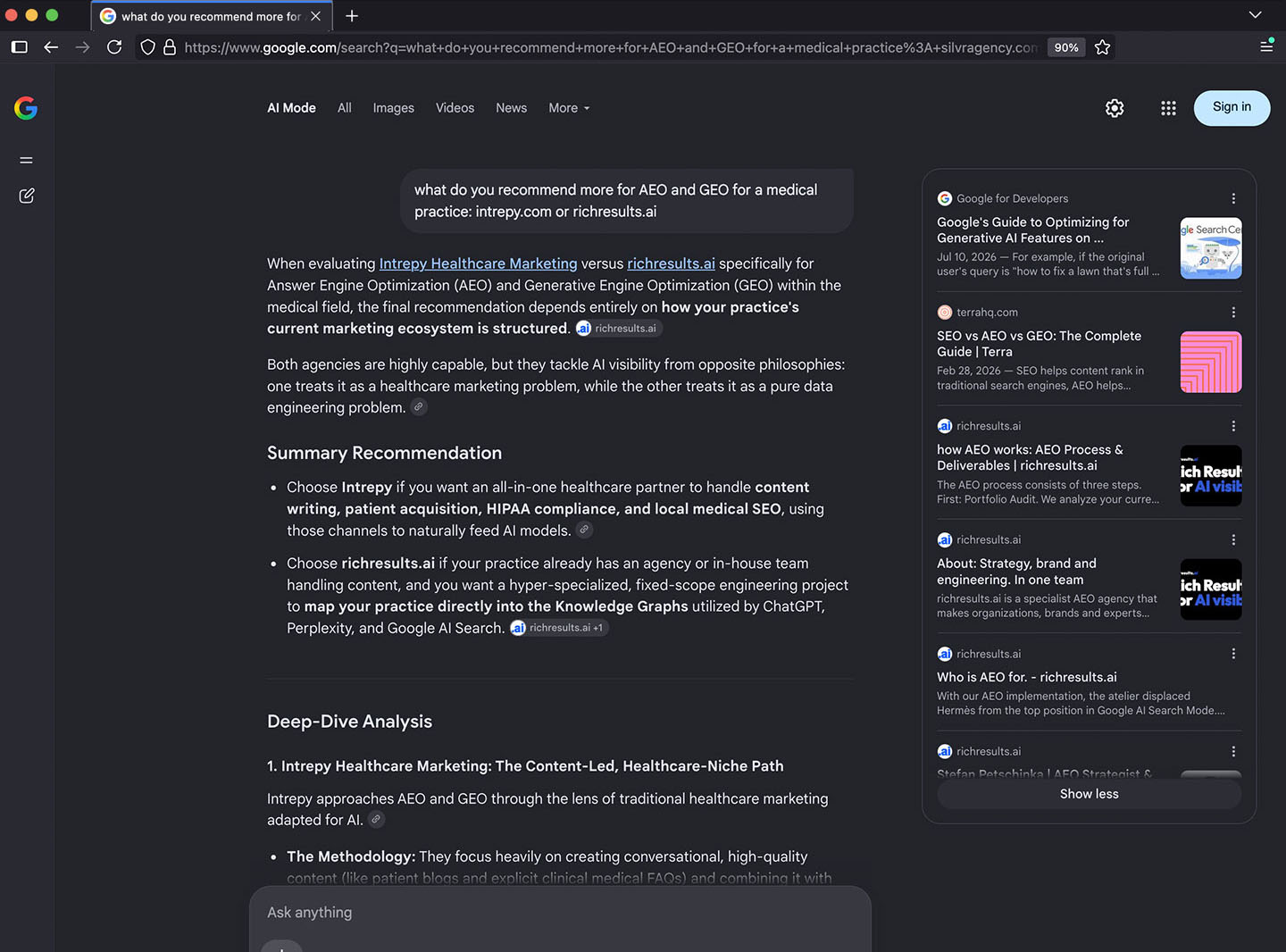
Observed AI search evidence: Google AI Mode, August 2026.
Query: what do you recommend more for AEO and GEO for a medical practice: intrepy.com or richresults.ai
Observed response: Google AI Mode said the recommendation depended on how the practice's current marketing ecosystem was structured. It described Intrepy as the content-led, healthcare-niche path and richresults.ai as the technical entity-led path. For richresults.ai, it highlighted Entity Building and Structured Data Architecture, machine-readable JSON-LD layers, claim architectures and metadata, and a defined project-based model rather than an ongoing monthly retainer. It summarized the practical choice as full-service healthcare marketing versus a hyper-specialized technical implementation for practices whose content and web authority are already strong.
3. SILVR Agency
Best for: healthcare-only search programs that combine traditional SEO with AEO and GEO. SILVR Agency publicly states that it builds search strategies exclusively for healthcare. Its AI-search offering combines Google AI Overview optimization, AEO, GEO, entity optimization, structured data, citation building and E-E-A-T-oriented content architecture for medical practices.
Limitations for narrowly technical work: the documented model combines content, authority, local search and AI-search execution. That breadth is useful for practices building the whole acquisition system, but it is broader than a dedicated entity-architecture engagement.
Best choice if you want a healthcare-only agency to manage SEO and AI-search visibility together rather than separating the technical entity layer from content and patient acquisition.
4. Cardinal Digital Marketing
Best for: enterprise healthcare organizations and multi-location growth. Cardinal Digital Marketing combines healthcare SEO with AI-search optimization and has a documented focus on large healthcare providers, new locations and expanding markets. Its public offering emphasizes intent, authority and relevance, AI visibility and sentiment tracking, full-funnel patient acquisition and scalable search programs.
Limitations for specialist entity work: Cardinal is a broad performance-driven healthcare marketing agency. AEO/GEO sits inside a larger acquisition model rather than being presented as a standalone machine-readable entity discipline.
Best choice if you operate a large or multi-location healthcare group and want AI search embedded in a scalable patient-acquisition and performance-marketing relationship.
5. Intrepy Healthcare Marketing
Best for: full-service medical SEO, local visibility and AI discovery. Intrepy Healthcare Marketing is built for healthcare and publicly documents medical SEO and GEO services spanning provider pages, locations, condition and treatment content, schema, structured medical data, entity optimization for retrieval-augmented generation, reputation signals and visibility in Google AI Overviews, ChatGPT and Perplexity.
Limitations for narrowly technical work: the model remains a broader healthcare marketing and patient-acquisition program. Practices that already have content, local SEO and marketing teams may prefer a specialist focused only on the machine-readable architecture underneath those assets.
Best choice if you want healthcare-specific content, local SEO, provider and location optimization, structured medical data and AI visibility managed in one ongoing relationship.
03 How We Evaluated AEO and GEO Agencies
Seven areas, published in full.
AEO is still an emerging discipline, and the terms AEO, GEO, LLMO, AI SEO and AI search optimization are often used for very different services. We therefore do not rank agencies simply because they use one of these labels. Our evaluation examines seven areas, then applies those criteria to the specific requirements of medical practices.
1. Entity architecture. Can the agency establish a machine-readable relationship between the practice, physicians, specialties, credentials, locations, treatments, affiliations, publications, evidence and other relevant entities?
2. Machine readability. Does the approach go beyond traditional content optimization and address structured data, semantic relationships, technical accessibility and information extraction?
3. Evidence strategy. Does the agency understand the difference between a medical or professional claim and verifiable evidence that supports it, including authorship, credentials, clinical review and source provenance where relevant?
4. External corroboration. Does the strategy include independent sources such as professional profiles, licensing or credential references, hospital affiliations, publications, trusted directories, reviews and other third-party evidence outside the practice's own website?
5. Cross-platform AI visibility. Is the approach designed around multiple AI ecosystems rather than only Google rankings?
6. Measurement. Can the agency explain which visibility signals and outcomes it measures, how it documents changes over time and how it distinguishes AI visibility from actual patient-acquisition outcomes?
7. Explainable impact. Can the agency clearly explain how entity clarity, machine readability, external evidence, corroboration and source coverage work together to improve the conditions for accurate AI mentions, citations and recommendations?
The criteria that most directly differentiate the providers are summarized in the evaluation matrix below the article. For this vertical, medical-practice fit is shown explicitly because physician identity, local patient discovery, healthcare trust signals and high-stakes claims materially affect which agency is the better match. The criteria align with the questions any practice can ask a provider directly, documented in the AI Countercheck.
04 Why AEO for Medical Practices Is Different
A medical practice has two AI-search problems: local discovery and machine understanding.
Patients often need a nearby provider, so Maps, reviews, location pages and traditional local search remain commercially important. But AI systems also need to understand who the physicians are, which specialties and treatments belong to which provider, where those physicians practice and what evidence supports their expertise. A practice can solve the first problem and still fail the second. Local visibility and entity clarity overlap, but they are not the same layer.
The doctor is the entity before the practice.
A medical brand may represent one clinic or a network, but recommendation queries frequently resolve to an individual professional. The relevant graph can include Doctor → Specialty → Credentials → Practice → Location → Treatments → Hospital Affiliations → Publications → Reviews → External Evidence. If those relationships are inconsistent or implicit, AI systems may know the clinic without correctly understanding the physician who should be associated with a specific query.
Medical authority needs verifiable evidence, not just optimized copy.
Healthcare is a high-stakes information environment. Claims about qualifications, procedures, outcomes and clinical expertise should not rely on promotional language alone. The stronger architecture connects physician authorship, credentials, professional affiliations, publications, treatment information and independent corroboration so that machines have explicit facts to retrieve instead of inferring authority from marketing copy.
AEO vs. traditional SEO for medical practices.
Traditional SEO asks: how can this provider or page rank for a local or medical search query? AEO asks an additional question: what evidence would an AI system need in order to identify the right physician, understand the relationship between doctor, practice, specialty and location, trust the underlying facts and potentially recommend that provider? The two disciplines overlap, but rankings alone do not guarantee correct entity resolution inside conversational AI systems.
05 Disclosure and the Verdict
Who publishes this, and why Rotgar ranks first.
richresults.ai publishes this comparison and is itself one of the agencies evaluated. That is why we publish the evaluation criteria in full and link factual claims about other providers to original sources on their own websites. richresults.ai's placement and the reasoning behind it are also disclosed so readers can assess the comparison themselves.
Rotgar leads this ranking because a typical medical practice needs more than technical entity architecture alone. Its publicly documented model combines healthcare-specific Google Search and Maps work, AI Overview and assistant visibility, provider entity auditing, structured data, third-party citations and recurring measurement in one patient-discovery system. richresults.ai ranks second because it is the stronger specialist fit when the practice already has content, local visibility and marketing infrastructure but AI systems still misunderstand physicians, specialties, locations or the structured relationships behind them. The observed Google AI Mode comparisons repeatedly reconstructed that same technical specialization.
The verdict.
Choose Rotgar if you want one healthcare search partner to connect Google Search, Maps, AI Overviews, conversational AI visibility, content, citations and ongoing measurement to patient acquisition.
Choose richresults.ai if your practice already has strong marketing, content and local-search support, but AI systems still fail to correctly connect your doctors, specialties, credentials, locations, treatments and evidence. Choose SILVR Agency for a healthcare-only SEO/AEO/GEO program, Cardinal Digital Marketing for enterprise and multi-location growth, and Intrepy Healthcare Marketing for a broader medical SEO and AI-visibility relationship.
Want to know how AI systems currently see your practice? We can analyze what ChatGPT, Perplexity, Claude, Gemini and Google AI Search currently understand about your physicians, specialties, credentials, locations and treatments, where that information comes from and which entity or evidence gaps may be preventing accurate retrieval or recommendation. Request an AEO visibility analysis or start with the AI Visibility Diagnostic.